Cascade Deletion
Article Type: Reference Audience: Developers Module: Data Models
Cascade deletion is a feature that ensures data integrity by automatically removing dependent records when a referenced record is deleted. This feature simplifies database management by reducing the need for manual intervention to maintain referential integrity. However, it should be used with caution to prevent unintended data loss, especially in complex database relationships.
Configuring Cascade Deletion
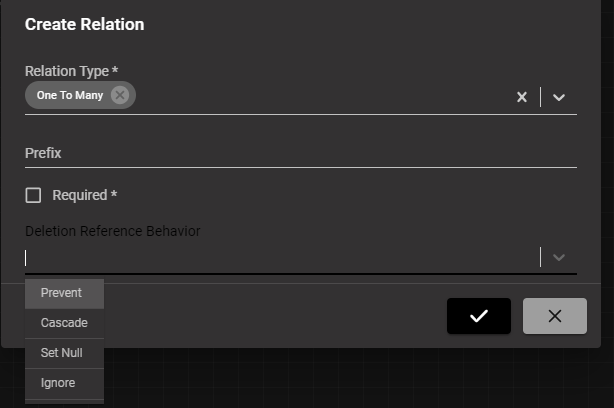
When configuring a relation on a data model, choose the desired Deletion Reference behavior from the options below:
- Prevent: This option prohibits the deletion of a record in the parent table if there are associated records in the child table(s). It enforces a restriction on deleting parent table records when related data exists in the child table(s), thus ensuring data integrity and preventing accidental deletion of critical records.
- Cascade: When a record in the parent table is deleted, all associated records in the child table(s) are also automatically removed. This ensures that no orphaned records remain in the database.
- Set Null: Upon deletion of a record in the parent table, the foreign key columns in the child table(s) are set to NULL. This severs the relationship between the parent and child records without deleting data. Note that this option necessitates that the foreign key columns permit NULL values.
- Ignore: Deletion of a record in the parent table does not affect the foreign key columns in the child table(s). This results in a broken relationship between the parent and child records without any data being deleted.